- The Dote
- Posts
- The Dote 2
The Dote 2
Yellowstone, Spot It, and squats

Stephen Olson
September 01, 2024
The Dote 2
What’s up friends!
We took a refreshing family trip to West Yellowstone this week and stayed in a cabin (that’s really more like a shack) on the edge of Lake Hebgen. More about that in a second, but first, thank you to everyone for the overwhelmingly positive feedback.
My first send was small, but almost everyone opened and read it, and almost everyone responded to me in some way. It was incredible! Writing into a void is intimidating, even if it is just to friends, so thank you for making it a positive experience.
I invited more people this week when we got back from Yellowstone, so if you missed last week’s post, you can look through the archive here.
Family Dote: “The Shack” at West Yellowstone
Last Friday we packed up the kids and drove to West Yellowstone to stay through the weekend with some of Hannah’s family at a cabin by Lake Hebgen. Back in the 1950s, Hannah’s grandparents went in with 4 other families on buying and building a cabin. The location could not be better, it’s right on the edge of the lake with it’s own little beach and dock. The land is technically owned by the Forest Service and they lease it. The cabin, however, is a little more like a shack than a cabin.
Built in something like 1956, the small cabin has 7ft ceilings, two small bedrooms, two bathrooms with tiny toilets, a kitchen, and a living room with a weird stuffed coyote head hanging on the wall above a fireplace. I think the cabin was originally built on a tight budget and since had almost 70 years of continued use, so it also has super old furniture, bats in the ceiling, and a sinking foundation that makes the whole room lean towards one corner. Every time we put Oakley down to crawl around he ended up rolling towards to sunken corner. If I had to rank it I’d say it’s a small step above camping in a tent and just below camping in an RV.
But you know what? None of that matters because the kids had an absolute blast. They played at lake from 9am to 7:30pm, only stopping 20 minutes to eat dinner. They didn’t care that the beach sand is really just rocks and gravel, or that the lake is 50 degrees and it was only 70 degrees outside, or that half the beach toys are broken and cracked, or that none of the lifejackets fit them very well. They were in the zone.
For a guy like me who regularly stresses about how I’m financially going to support six kids (maybe a topic for another day), it was a refreshing reminder that nice stuff and amenities don’t matter to them. They just want to be loved and be creative.
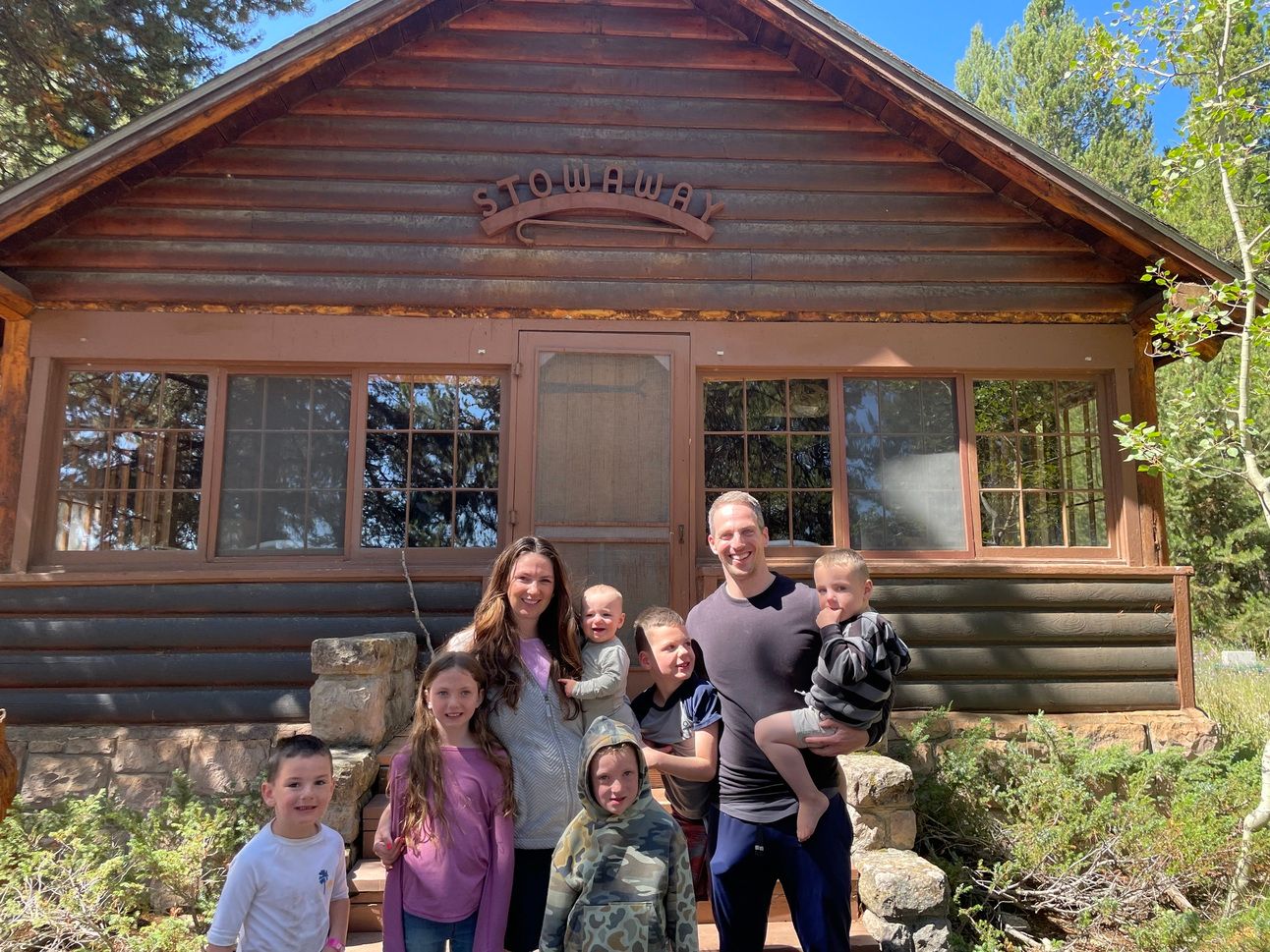
Here’s us outside the cabin
Random thoughts: The “Spot It! Effect”
I played a lot of Spot It! with the kids while we were at the cabin. If you’ve never played Spot It before, it’s basically a matching game for time. Each card has eight pictures on it and has exactly one match to every other card in the deck. The goal is to find the match as fast as possible as many times as possible.
If you have played, you’ve hopefully experienced the feeling of extreme confidence when you’re in the zone, finding the matches almost instantly. You’ve probably also felt the despair when someone else is beating you and you can’t find a match for so long you start to wonder if the cards are broken.
My kids are very vocal about their mental state while they play, especially if they’re not winning. Sometimes, after they get frustrated and have been staring at the cards for a long time, I want to help them out. At first, I used to whisper the match out loud and they would repeat it. Next, I learned to suggest a color so they could still do some of the work. Eventually, I learned that the best, most effective way to help is to just tell them “I see it.”
Three simple words that tell them nothing about how to find the match, yet 99% of the time leads them find it within 5 seconds.
Not only have I tested this pattern with my kids in Spot It, but also in picture games, word searches, and puzzles. It’s like as soon as they know that there is a solution, something switches in their brain - or, more accurately, like something becomes unblocked, and they instantly break through to the solution.
At least part of this phenomenon has been studied, it’s called Psychological Momentum. The idea that when you get in a good mental state you build compounding momentum that increases your performance. While looking for an explanation I read an article that studied psychological momentum (PM) in athletes and found it to “play a critical role in goal pursuit and achievement.” Not only that, it’s available to everyone and for just about anything. This quote was awesome:
“[PM] is ubiquitous, ranging from doing household chores to trading stocks, driving in traffic, winning Presidential primaries, and beating opponents in sports. When NBA star Stephen Curry gains momentum in making baskets, he is no different than a person who gets on a roll doing household chores–vacuuming room after room, tidying, and dusting (i.e., beating the opponent of the dirty house).”
Apparently I can get the same psychological high as Steph Curry by vacuuming?! Count me in!
But there’s something more about knowing something is achievable — that frame-breaking moment when you realize what you thought was impossible is possible, that makes achieving it so much easier. I quickly think of some frame-breaking moments in sports history, like Roger Bannister breaking the 4-minute mile or Eddie Hall recording a 500kg deadlift (ps if you’ve never seen his behind the scenes about it, it’s a good watch).
There are also frame-breaking moments in science, like going to space or breaking the sound barrier, that now seem like small fish.
I don’t know what that phenomenon is called, but I call it the “Spot It Effect,” and the question I asked myself this week was, “how can I expose myself and my kids to more of the Spot It Effect?”
I don’t know the answer yet, but I feel like anyone who can harness the power of psychological momentum and exposure to frame-breaking achievements is bound to be inspiring and successful.
The Fitness Dote: The Russian 🍑 continues to grow
On the topic of frame-breaking moments — I had one this week on Friday when I completed Session 14 of the Russian Squat Program. The workout was 3×3 at 95% of my 1RM back squat, which for me is 346 lbs.
When programming for strength training, there are two important metrics to gauge intensity:
Actual (or absolute) intensity: The difficulty of a specific movement. For example: 95% of your 1 rep max.
Relative intensity: the difficulty of a set of movements. For example, Session 14’s prescribed workout is 3×3 at 95%. Doing 95% 3 times has the relative intensity of 105%, meaning it’ll feel 5% harder than a 1RM.
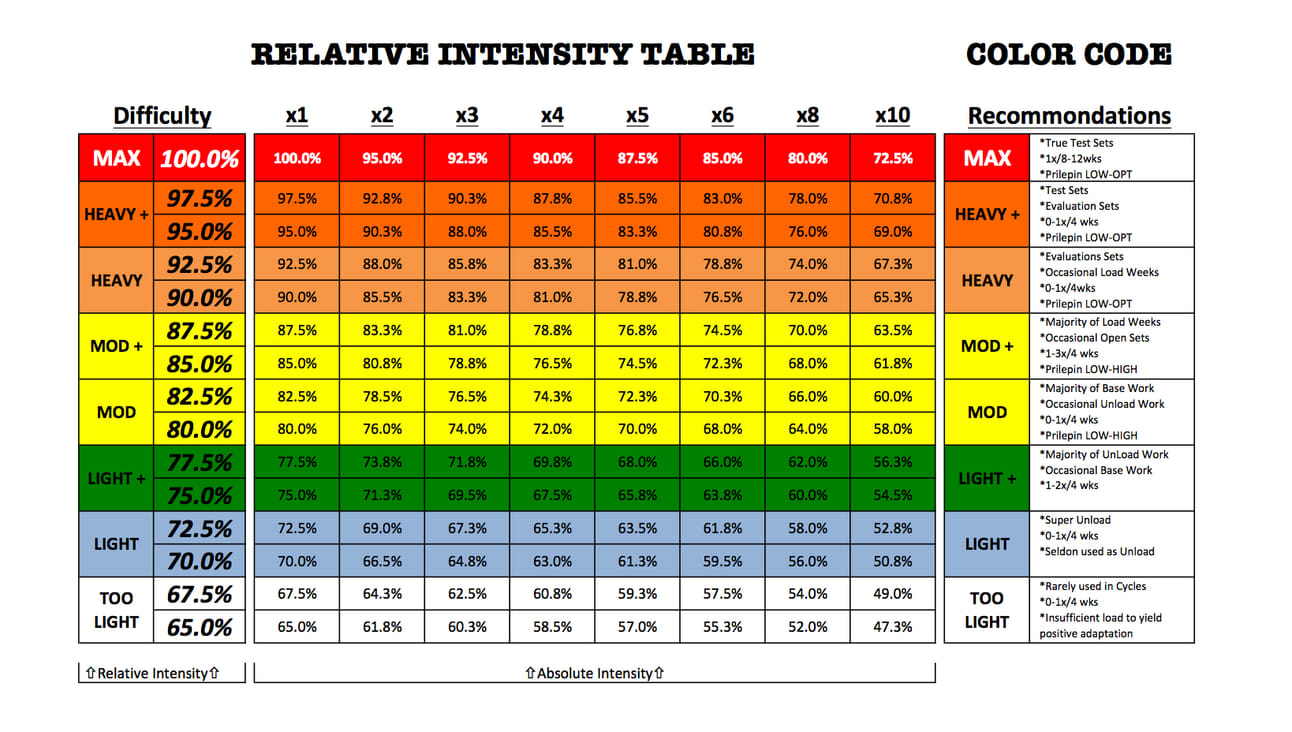
Relative intensity chart

I had been stressing about this session for weeks because of how heavy this is. Completing Session 12 of a 4×4 @90% (100% RI) gave me a bit of confidence, and I keep telling myself that this program is tested and proven on thousands of athletes.
TLDR, I did completed all the reps! I’ve legitimately never felt so close to dying under a barbell 😂 No one is more shocked than me that I completed all the reps.
I’m so pumped about it that I made a video to document it. Literally the first video I’ve ever spliced and edited since using iMovie back in high school (update: technology is way better now).
I’m too insecure to post it to social media, but hopefully you don’t mind me sharing it with you guys cuz it’s meaningful to me. I’ve set big lifting goals for myself and this is progress.
That’s enough jabber for this Dote. Until the next one! Please shoot me a text or send a reply if you’ve made it this far. I thrive off your approval 😂